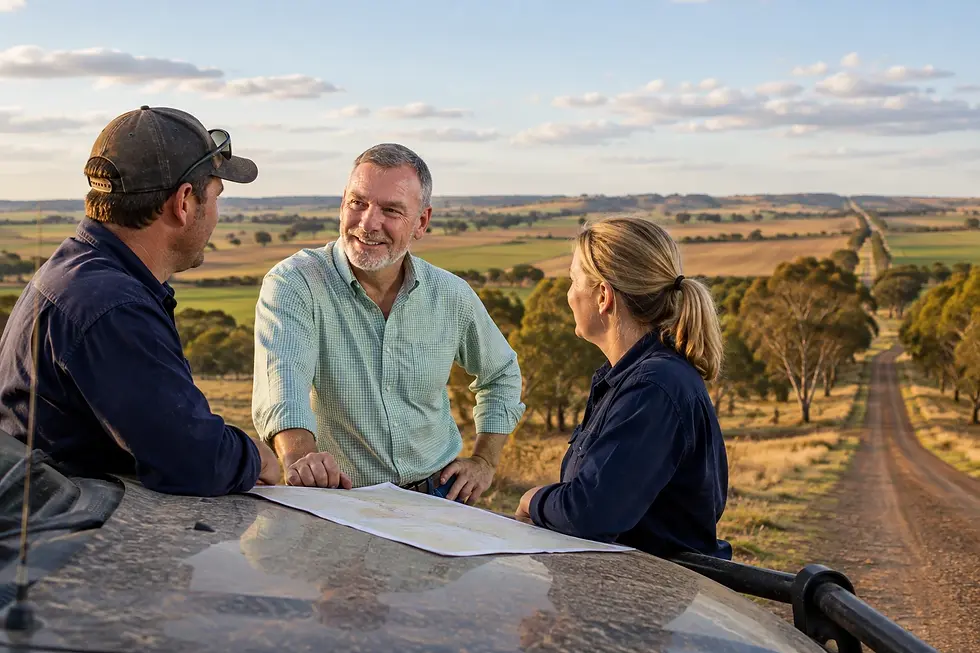
Most Farm Reports Start With Numbers. I Start With Five Questions.

Farm business reports usually begin with the numbers: income, costs, profit, cash flow, debt and a collection of ratios explaining how the business performed.
Those numbers matter. But they are not where I begin.
Before opening the spreadsheet, I want to understand what the farming family is trying to achieve, what the business is expected to provide and which decisions are sitting ahead of them.
Since starting AF Consulting in 2021, I have become increasingly convinced that useful farm business analysis does not begin with more numbers.
It begins with better questions.
1. What Does the Family Need the Farm to Deliver?
Every farming family expects something from the business.
It might be reliable family income, debt reduction, machinery replacement, support for retiring parents or an opportunity for the next generation. Perhaps the aim is to buy more land, employ additional labour or simply become less exposed when the season turns against them.
“Make the farm more profitable” is a reasonable ambition, but it is difficult to plan around.
How much profit is needed? How much cash needs to remain after family drawings, loan repayments and farm investment? What does the business need to achieve each year to keep moving towards the family’s longer-term goals?
There is no single financial result that suits every farm.
The first question is whether the farm is producing enough for what the family needs it to deliver.
2. What Is the Farm Business Really Earning?
A big harvest, strong livestock sale or good wool cheque can make the year feel successful.
But sales income is not profit.
I want to know what value the farm produced, what it cost to produce it, what Gross Margin remained and what it cost to run the wider business.
What remains from normal farming operations is the Operating Surplus—the profit available before interest, tax, loan principal, family drawings and major farm investments.
One good season can make a weak cost structure look acceptable. One poor season can make a sound business look worse than it really is.
That is why I generally want to see several years. The trend often tells us more than one result.
3. Where Did the Cash Go?
This is often where the most useful discussion begins.
A farm can report a profit while the bank balance barely improves—or debt actually increases.
The cash has usually gone somewhere: family drawings, interest, tax, loan repayments, machinery, infrastructure, livestock or additional working capital.
None of those uses is necessarily wrong.
But the family needs to understand the connection between the profit the farm generated and what remained afterwards.
Profit tells us what the business earned. Cash analysis tells us what happened to it.
A profitable farm that consistently retains very little cash may struggle to reduce debt, invest or absorb a poor season.
4. What Is Driving the Result?
Once the result is clear, I want to know why it happened.
Was it production, price, input costs, machinery, labour, enterprise mix or simply the season?
If grain income fell, was it price, yield or both? If livestock income weakened, was it sale weight, numbers, timing or market price? If turnover increased but profit did not, which costs absorbed the extra income?
The purpose is not to explain every movement in the accounts.
It is to identify the few things that made the greatest difference—and separate what happened to the business from what happened because of decisions within the business.
That is where opportunities to manage the next result differently begin to appear.
5. What Needs to Happen Next?
This is where a farm report should earn its place.
A report that accurately describes the past but leaves the family with twenty observations has not necessarily made the next decision any easier.
What are the two or three issues that matter most?
Does the farm need to improve profitability, retain more cash, reduce debt, reconsider machinery spending or strengthen the existing business before pursuing growth?
The Plan sets out what the family intends to achieve. The Forecast changes as seasons, prices and production expectations change.
Forecasting cannot remove uncertainty from farming.
It can, however, reduce the chance of being surprised by something the numbers were already beginning to show.
My Observation
Farm financial reports are often technically sound. The weakness is when they begin and end with the numbers.
The value comes from connecting those numbers to what the family needs, what the farm is genuinely earning, where the cash is going, what is driving the result and what should happen next.
That is the heart of the AF Consulting approach.
A farm report should finish with better decisions, not better filing.
AF Consulting helps family farms understand the business behind the farming and turn financial information into confident business decisions.
To discuss what your farm’s numbers are quietly telling you, call or email me, Robert at AF Consulting.